
How badminton shuttlecocks are made: 6-stage Jiangshan factory process and QC standards
Every feather shuttlecock produced in our Jiangshan workshop passes through 6 precision manufacturing stages: raw feather washing and drying, optical curve and shaft thickness grading, 16-hole angled cork drilling, uniform feather insertion, double cotton-thread lacing with resin curing, and 100% spin, trajectory and speed calibration (74–79).
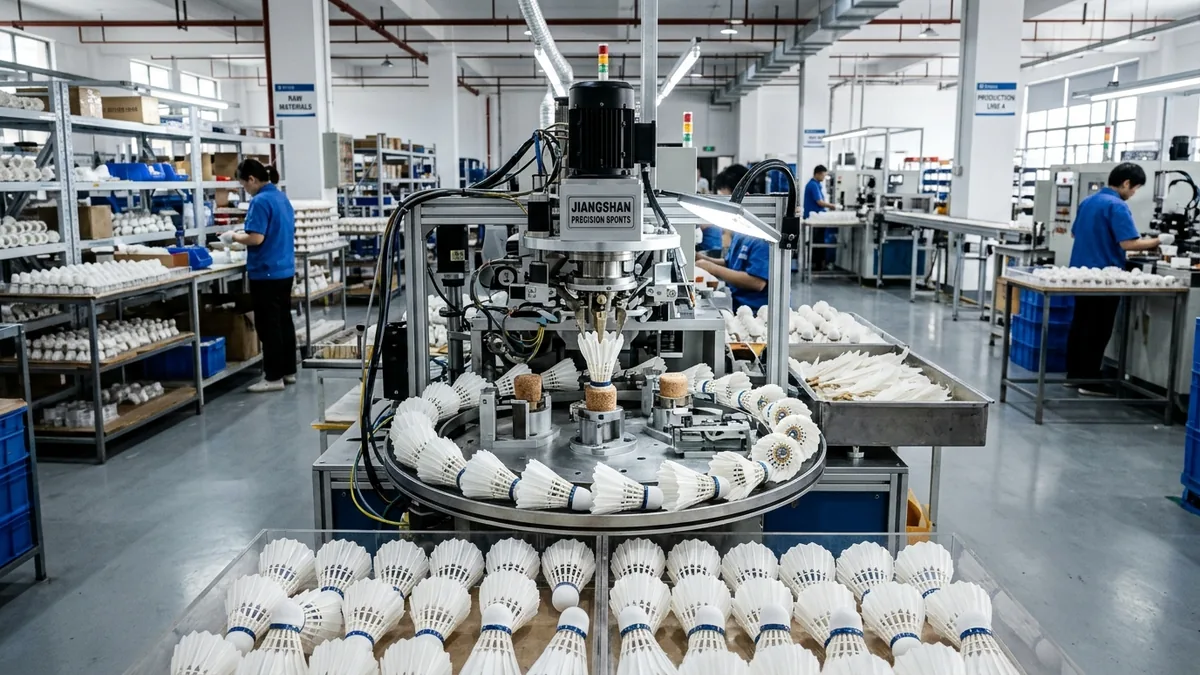
6-stage shuttlecock factory production & quality control tolerances
Inspection parameters enforced across our Jiangshan production lines before tubes are packed into 50-tube export cartons.
| Production stage | Core workshop operation | Engineering tolerance | Defect prevented on court | Inspection method |
|---|---|---|---|---|
| 1. Washing & drying | Degreasing wash, peroxide/natural whitening & 55%–65% RH conditioning | 10%–12% internal shaft moisture | Brittle shaft snaps & mold spots | Batch hygrometer & flex check |
| 2. Feather sorting | Left/right wing separation, arch gauge & thickness sorting | ±0.05 mm rachis thickness per set of 16 | Axial wobble & uneven spin speed | Optical laser gauge & master sorter |
| 3. Cork drilling | 16-spindle radial drilling into natural or 2/3-layer composite cork | 25–26 mm head diameter · uniform depth | Loose feathers & off-axis center of gravity | Pin-gauge depth & angle fixture |
| 4. Skirt insertion | Sequential implantation of 16 matched feathers into cork sockets | 65–68 mm skirt diameter · 62–64 mm height | Parachute flare or tight bullet flight | Ring diameter & height gauge |
| 5. Lacing & gluing | Double-knotted coil stitching & inner/outer resin collar curing | Even thread tension across all 16 stems | Collar splitting on off-center frame hits | Centrifugal cure & pull-force test |
| 6. Flight & speed QC | Rotation test (320–380 rpm), baseline landing & weight grading | ±0.10 g weight band per speed number | Wobbly flight or clears sailing out | Mechanical launcher + human court test |
Stages 1 to 3: raw feather conditioning, 16-feather matching and cork drilling
Flight stability is decided before a single feather touches the cork. If one feather out of 16 has a different arch curvature or shaft stiffness, the shuttlecock will wobble in mid-air.
Left-wing vs right-wing separation
Goose and duck wing feathers curve naturally in opposite directions on the left and right wings. Mixing left and right feathers cancels aerodynamic torque; we sort them into 100% single-side sets.
5-parameter optical & tactile grading
Feathers are sorted into micro-lots by curvature arch, rachis wall thickness, vane width, surface whiteness and natural oil sheen so all 16 feathers in one shuttlecock behave identically.
Precision 16-hole compound-angle cork drilling
Whether using a 3-layer natural top cork, 2-layer composite cork or particle cork, our rotary CNC drills bore 16 equidistant sockets at the exact tilt angle required for a 65–68 mm skirt.
Stages 4 to 6: skirt assembly, resin collar curing and baseline flight testing
Once the 16 matched feathers are seated into the cork head, mechanical thread tension and resin formula determine how many rallies the shuttlecock survives.
Double-thread lacing & resin curing
Automated stitching machines lock each feather shaft with high-tenacity cotton cord, followed by centrifugal application of impact-resistant resin glue that penetrates the thread knots without adding excess weight.
100% spin & wobble stability grading
Each shuttlecock is fired across an indoor test lane to observe axial rotation. Shuttles with zero visible wobble qualify for match grades (GL-1, CG-1, G10), while minor-variance units are routed to practice tiers.
Electronic weight & speed 74–79 binning
Electronic scales sort finished shuttles into 0.10 g increments (4.7 g to 5.2 g), verified against the BWF 530–990 mm baseline landing zone before foil-tube sealing.
Catalog models featured in this guide
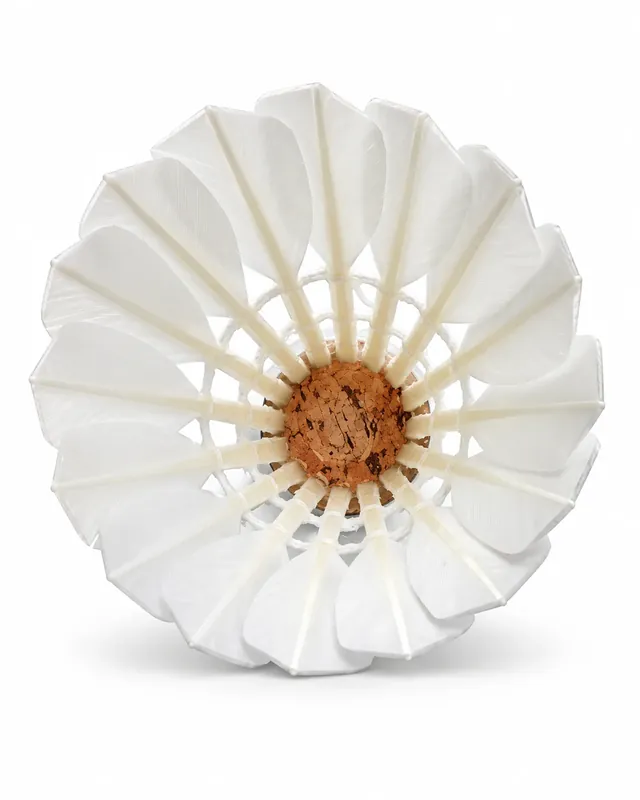
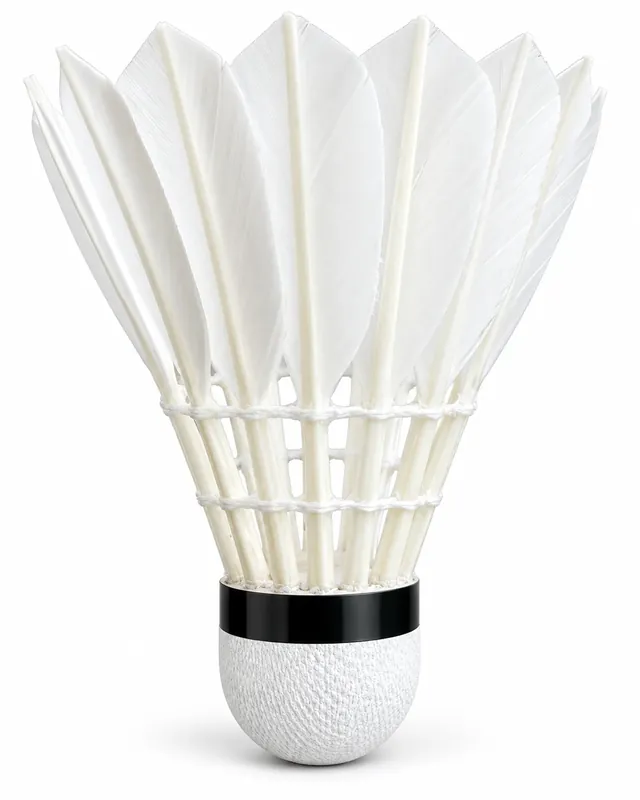
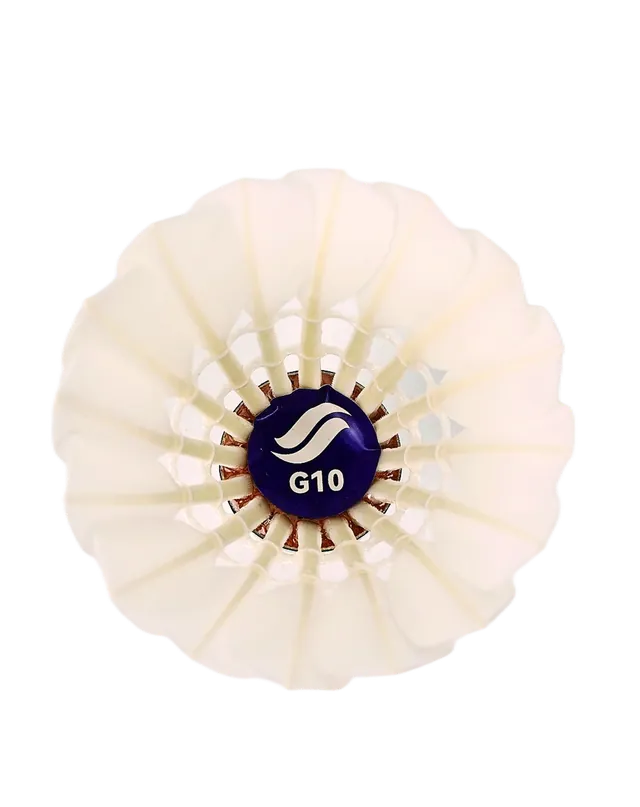
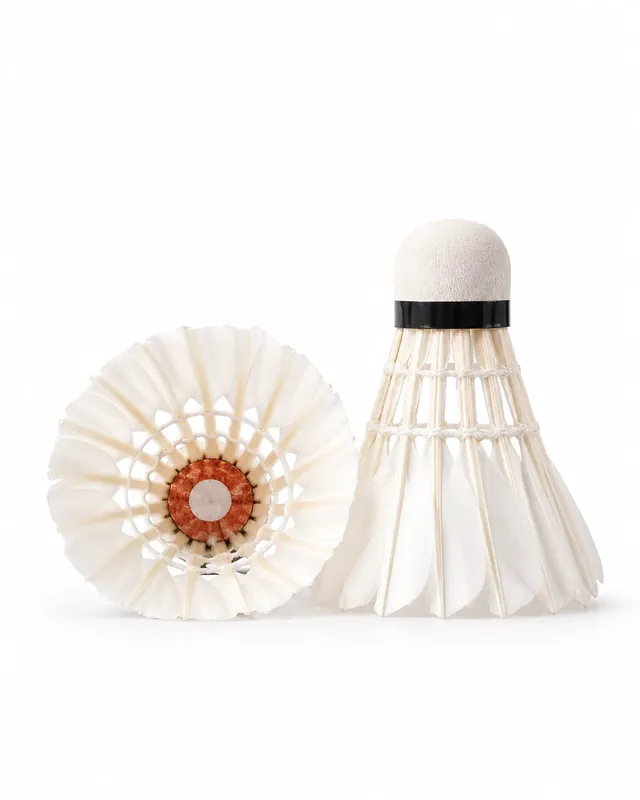
Compare indicative USD EXW reference pricing per tube, save models to your inquiry list, or request 3 free play-test shuttlecocks.
Feather material questions
Why must all 16 feathers on a shuttlecock come from the same wing side?
Left-wing and right-wing feathers have opposite aerodynamic camber. Using 16 feathers from the same wing side creates uniform air deflection so the shuttlecock spins smoothly at 320–380 rpm and stabilizes its nose-down trajectory.
How many raw feathers are needed to make one dozen (12) tournament shuttlecocks?
Each 12-shuttle tube requires 192 finished feathers, which are selected from roughly 350 to 450 raw wing primaries after rejecting stems with curve, thickness or vane blemishes.
How does the factory prevent glue from cracking in cold winter halls?
We use a toughened polyurethane-modified resin adhesive cured under controlled temperature and humidity so the glue collar retains micro-elasticity even in 8–15°C winter halls.
Can wholesale buyers request pre-shipment QC videos of their batch?
Yes. For every wholesale and OEM order, our Jiangshan QC team records batch weight logs, skirt diameter checks and indoor test-lane flight videos before carton sealing.
Continue reading related factory guides
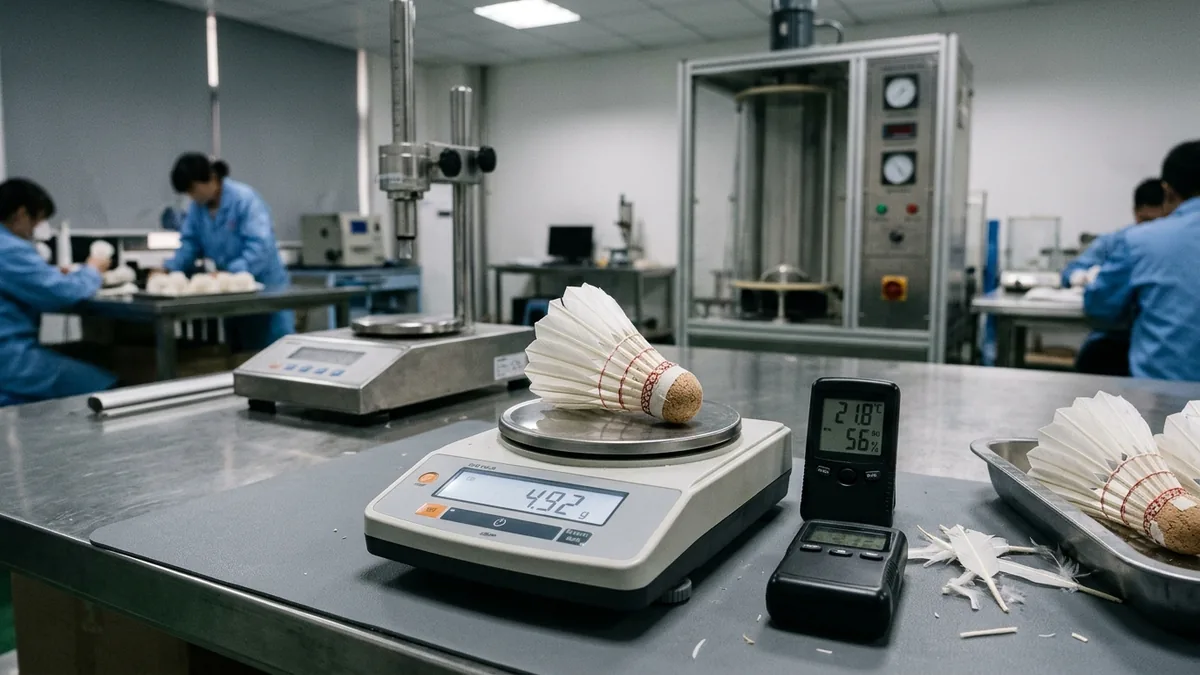
Shuttlecock speed chart (74–79): temperature, altitude and baseline test guide
Use our factory shuttlecock speed chart (74–79) to match court temperature, altitude and air density, plus how to run the BWF baseline landing test.
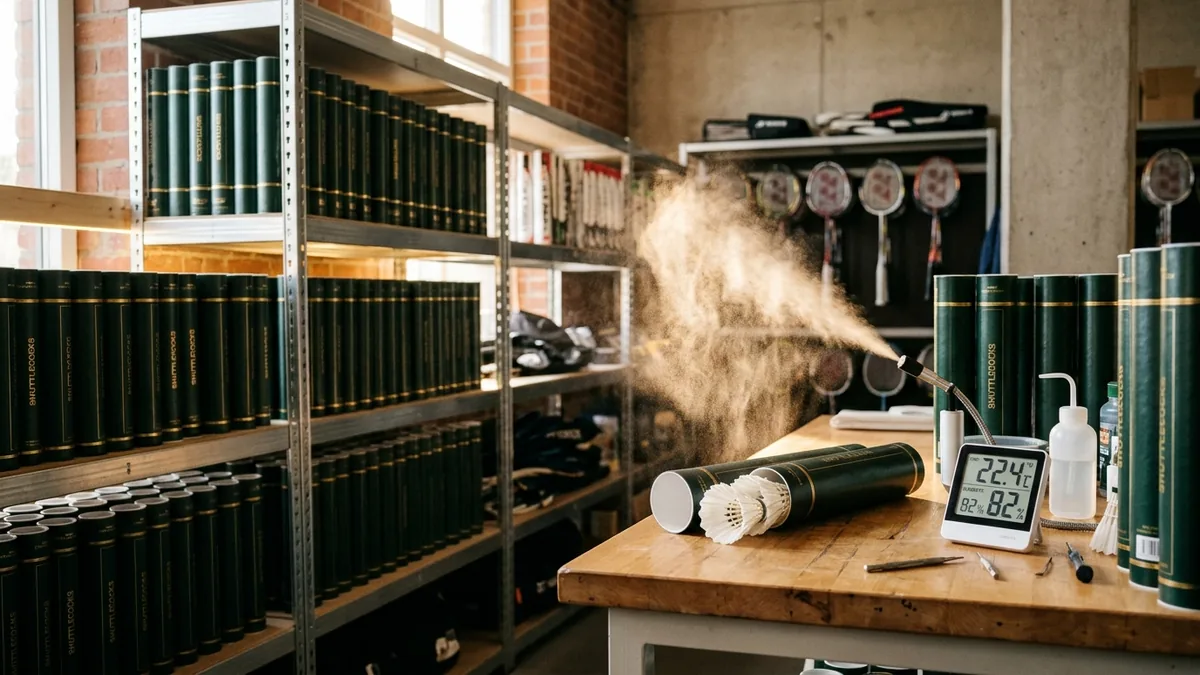
How to store and humidify feather shuttlecocks: 55%–65% RH club & warehouse guide
Learn how to store and humidify goose and duck feather shuttlecocks at 55%–65% RH and 15–25°C to prevent brittle shafts and extend rally durability.
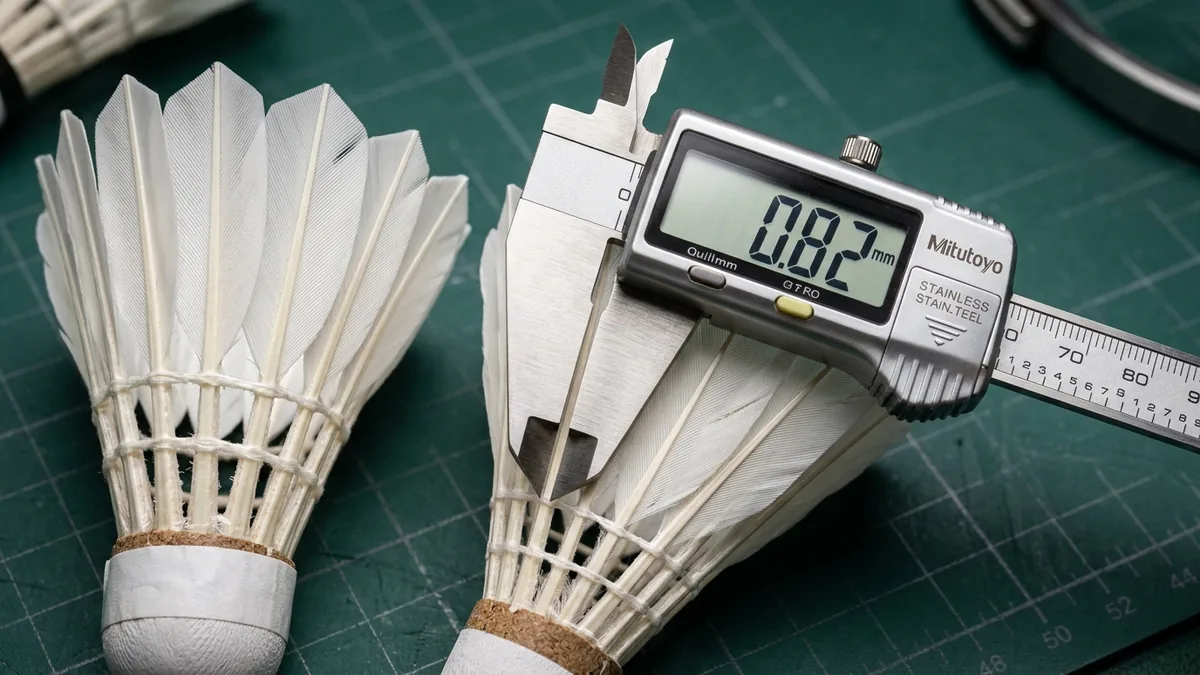
Goose vs duck feather shuttlecocks: anatomy, durability and club cost comparison
Compare goose vs duck feather shuttlecock durability, shaft anatomy, Mulard/Cigu/Teng species differences and cost-per-set across 80 factory models.